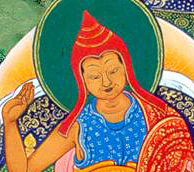
Kamalaśīla


| PersonType | Category:Classical Indian Authors |
|---|---|
| MainNamePhon | Kamalaśīla |
| MainNameTib | པདྨའི་ངང་ཚུལ་;ཀ་མ་ལ་ཤཱི་ལ་ |
| MainNameWylie | pad+ma'i ngang tshul;ka ma la shI la |
| MainNameSkt | Kamalaśīla |
| SortName | Kamalaśīla |
| bio | Kamalaśīla (Tib. Padma’i ngang tshul; c. 740-795 CE, Frauwallner, 1961, 144) was a monk and scholar best known as the disciple and commentator of Śāntarakṣita (c. 725-788) and the representative of Indian Buddhism in the so-called Bsam yas debate (792-794, Demiéville, 1952, 177). He made a number of original contributions to Indian Mahāyāna thought, championing and further developing Śāntarakṣita's *Yogācāra(-Svātantrika)-Madhyamaka syncretic system (Keira, 2004, 4-9). He was a prolific writer, and his erudition, attention to detail, and eloquence mark his corpus as one of the richest sources in the history of 8th-century Indian interreligious philosophical exchange. Like his teacher, his work demonstrates vast learning in the major philosophical traditions of his time, Buddhist and non-Buddhist alike, as well as a commitment to rational analysis and argumentation. (Source: "Kamalaśīla," in Brill's Encyclopedia of Buddhism, Vol. 2, 272) |
| YearBirth | 713/740 |
| YearDeath | 763/795 |
| ReligiousAffiliation | Nalanda |
| StudentOf | Śāntarakṣita |
| BDRC | https://www.tbrc.org/#!rid=P7641 |
| IsInGyatsa | No |
| BnwShortPersonBio | One of the most important Madhyamaka authors of late Indian Buddhism, a major representative of the Yogācāra-Madhyamaka synthesis, and a participant in the famous Bsam yas Debate. According to Tibetan doxographies, he was a proponent of the Yogācāra-Svātantrika-Madhyamaka. Although little is known about his life, according to Tibetan sources he was a monk and teacher at Nālandā. Tibetan sources also count him as one of three (together with Śāntarakṣita and Jñãnagarbha) “Eastern Svātantrikas” (rang rgyud shar gsum), suggesting that he was from Bengal. He was clearly a direct disciple of Śāntarakṣita, composing important commentaries on his teacher’s two major works, the Madhyamakālaṃkāra and the Tattvasaṃgraha. The latter commentary, which is extant in Sanskrit, is an important source for both Hindu and Buddhist philosophical positions in the eighth century. (Source: "Kamalaśīla." In The Princeton Dictionary of Buddhism, 411. Princeton University Press, 2014. http://www.jstor.org/stable/j.ctt46n41q.27.) |
| PosBuNayDefProv | Provisional |
| PosBuNayDefProvNotes | "In another context, Kamalaśīla quotes the passage from the Laṅkāvatārasūtra cited by Candrakīrti as scriptural authority for Buddha-nature being of provisional meaning. Kamalaśīla himself, though, does not put it quite that way, stating only that, in accord with the various outlooks of sentient beings, the Buddhas taught what is a single dharmadhātu (or dharmanairātmya in the Laṅkāvatārasūtra) by means of many different expressions (including the expression “Buddha-nature”), that is, in conventional terms." Kazuo Kano, Buddha-Nature and Emptiness, p.11. |
| PosAllBuddha | Qualified Yes |
| PosAllBuddhaNote | In the sense that all beings have the potential to achieve Buddhahood. |
| PosAllBuddhaMoreNotes | "The teaching “all sentient beings have Buddha-nature” is
interpreted in the sense that all sentient beings are pervaded by the dharmadhātu, which is characterized by selflessness. In other words, the tathāgatagarbha is taken to be the dharmadhātugarbha. Though the term dharmadhātugarbha appears in the RGVV, Kamalaśīla's interpretation seems to have been derived from a phrase in the Laṅkāvatārasūtra, “the embryo of the tathāgata, which is selflessness” (tathāgatanairātmyagarbha), reinforcing the notion that Buddha-nature does not refer to ātman but rather to selflessness (nairātmya)." Kazuo Kano, Buddha-Nature and Emptiness, p. 10. |
| PosYogaMadhya | Madhyamaka |
| PosVehicles | 1 |
| PosVehiclesNotes | "In his Madhyamakāloka, Kamalaśīla presents the position of an opponent who takes the three-vehicle theory to be definitive. He refutes that position and makes the case for the single-vehicle theory being definitive by quoting a number of sutra passages." Kazuo Kano, Buddha-Nature and Emptiness, p. 9. |
| PosEmptyLumin | Tathāgatagarbha as the Emptiness That is a Non-implicative Negation (without enlightened qualities) |
| PosEmptyLuminNotes | Though he might be an early antecedent to the position that combines emptiness and luminosity, Brunnhölzl counts him among those that hold this position.
|
| Other wikis |
If the page does not yet exist on the remote wiki, you can paste the tag |